Performance Bond Guide
SuretyBonds.com offers the best service and fastest delivery for construction performance bonds in the industry. Learn how to get yours in this quick guide.
Bond Overview
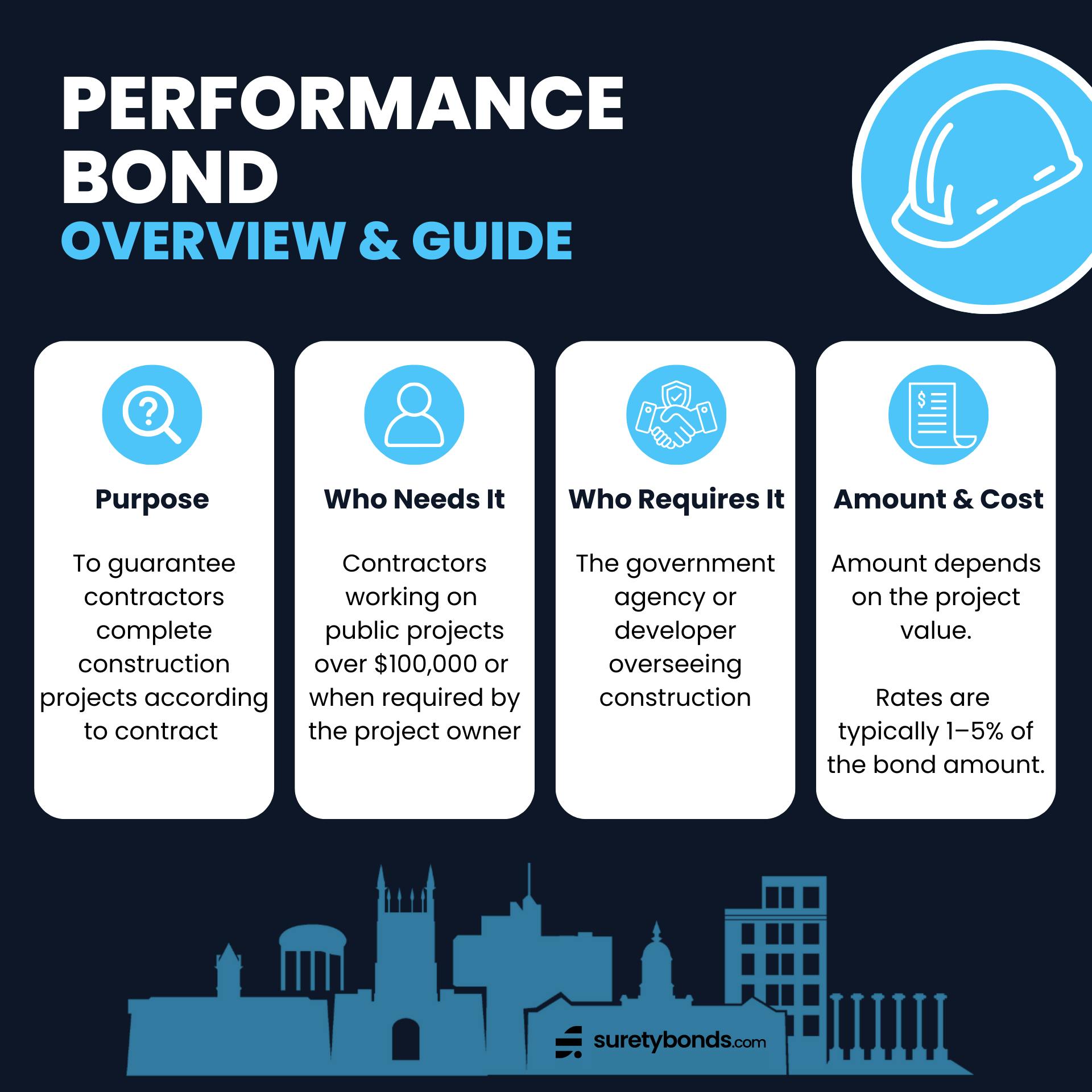
- Purpose: To guarantee general contractors complete construction projects according to the agreed-upon terms
- Who Needs It: Contractors working on public projects over $100,000 or when otherwise required by the project owner
- Regulating Body: The government agency or developer overseeing construction
- Required Amount: The value of the project at hand
- Premium Rates: Typically 1–5% of the coverage amount, based on underwriting review
Continue reading to learn how to get bonded quickly and easily.
What Is a Performance Bond?
A performance bond is a guarantee that a contractor will complete a construction project according to the agreed-upon contract. If a contractor defaults on a project, the bond amount is used to recover the project owner’s losses.
SuretyBonds.com is the nation’s top surety provider. We offer the best service, fastest delivery and most affordable performance and payment bond prices in the industry.
When Do You Need a Performance Surety Bond?
When a developer wants to protect the investment made in a venture, the winning contractor must provide a performance bond before starting work. Many contractors will get their performance bond at the same time as their payment bond for a new project.
How Much Does a Performance Bond Cost?
Your performance bond premium will vary based on the project’s bid amount, your financial credentials and your past work history. Bond rates fluctuate between 1% to 5% of the total contract amount.
Most qualified contractors can expect to pay a price of 2.5–3% of the performance bond amount. This means if you’ve been contracted for a $100,000 project, you could pay just $2,500–$3,000 for your construction performance bond.
How to Get a Performance Bond
To get a performance bond, contractors need to apply with a surety provider. If the construction project amount exceeds $750,000, applicants must provide additional financial credentials.
Standard bond application questions include:
- How much is your bid?
- When is the bid date?
- Have you ever been bonded before?
- How long has your company existed?
- What is your credit score?
Once financial records are reviewed, the application is approved and payment is received, an underwriter will issue the bond. Apply online now or call 1 (800) 308-4358 to speak with a surety expert.
How Does a Performance Bond Work in Construction?
The Federal Miller Act mandates contract surety bonds for all public construction projects exceeding $100,000. Some state and municipal laws also require performance bonds on smaller public construction projects. These laws are now known as “Little Miller Acts.”
Many private project owners also require contractors to provide surety bonds, although not required by law.
Which Parties Are Involved?
Performance bonds bind three entities together in a legal contract:
- The Principal: The contractor who signs and pays for the bond to guarantee performance
- The Obligee: The government agency or project owner requiring the bond
- The Surety: The provider issuing the bond and backing the contractor
By bringing a third-party surety in to execute the agreement, this process reassures the performance bond will guarantee rightful compensation to those involved.
What If a Contractor Defaults on a Construction Project?
If a contractor fails to complete a construction project as promised, the developer may file a claim against the surety bond to recoup their losses.
If the surety deems the claim as valid, they will take corrective action and repay the owner up to the full bond amount or use the funds to complete the project with another contractor.
Understanding Types of Construction Bonds
Performance Bonds vs. Payment Bonds
Performance bonds are often issued in conjunction with payment bonds, but they serve different purposes. Payment bonds guarantee payment for services throughout a construction project while performance bonds guarantee project completion.
Performance Bonds vs. Contract Bonds
Contract bonds are any type of surety bond used to ensure construction projects follow contract terms. A performance bond is a specific type of contract bond that guarantees satisfactory project completion by the contractor.
Performance Bonds vs. Bid Bonds
Both of these are types of construction surety bonds and often go hand-in-hand. Bid bonds are necessary to ensure all proposals are valid during the bidding process. After winning a bid, a contractor then files a performance bond to ensure project completion.
Rural Utilities Service (RUS) Bonds
Contractors working on projects greater than $250,000 for the Rural Utilities Service (RUS) infrastructure must file a specific RUS performance bond to guarantee proper completion.