For federal projects and contracts, you’ll typically need a surety bond from a T-Listed surety company. The U.S. Department of the Treasury publishes an annual list of approved sureties called the Circular 570.
At SuretyBonds.com, we partner with multiple T-Listed surety companies to ensure your bond forms are always accepted. Continue reading to learn more about why T-Listed sureties are important to the bonding process.
What Is the Circular 570?
The Treasury Circular 570, commonly known as the “T-List”, is the official list of surety companies that are compliant with U.S. Treasury laws and regulations. These are sureties that the federal government trusts to back its projects.
Once approved, sureties receive a Certificate of Authority to write federal bonds under Title 31 of the United States Code, Sections 9304 to 9308. They must renew this certificate annually.
What Information Can I Find in Circular 570?
The T-List includes the following information for each approved surety:
- Business address
- Phone number
- State of registration
- States where it’s licensed
- Underwriting limitations
T-Listed sureties can technically write bonds above their limitations. However, they must protect the excess amount through a Treasury-approved method, such as reinsurance or co-insurance.
How Does a Surety Qualify For the Treasury List?
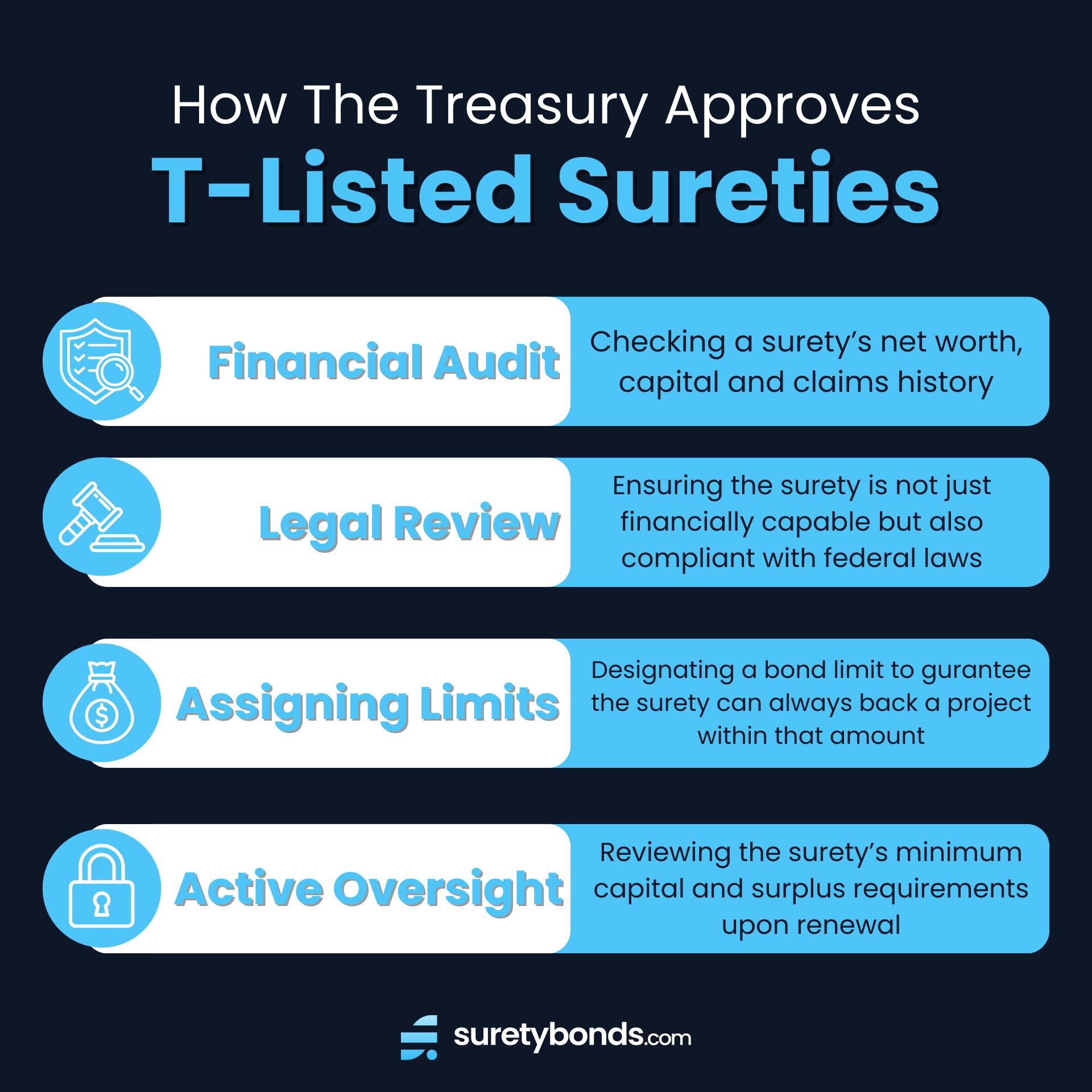
Surety companies undergo a rigorous process when applying for a Certificate of Authority. This includes financial auditing that checks their net worth, capital and claims history. The sureties must also comply with U.S. laws and regulations.
The Treasury then establishes underwriting limitations. Surety companies typically can’t write a single bond for more than 10% of their net worth. To maintain their certificates, sureties must continue to meet minimum capital and surplus requirements.
Sureties that don’t demonstrate the appropriate capital to handle federal projects cannot be approved for the T-List. This process guarantees that every surety on the list will consistently be able to back large federal projects.
How Do I Know If I Need a T-Listed Surety?
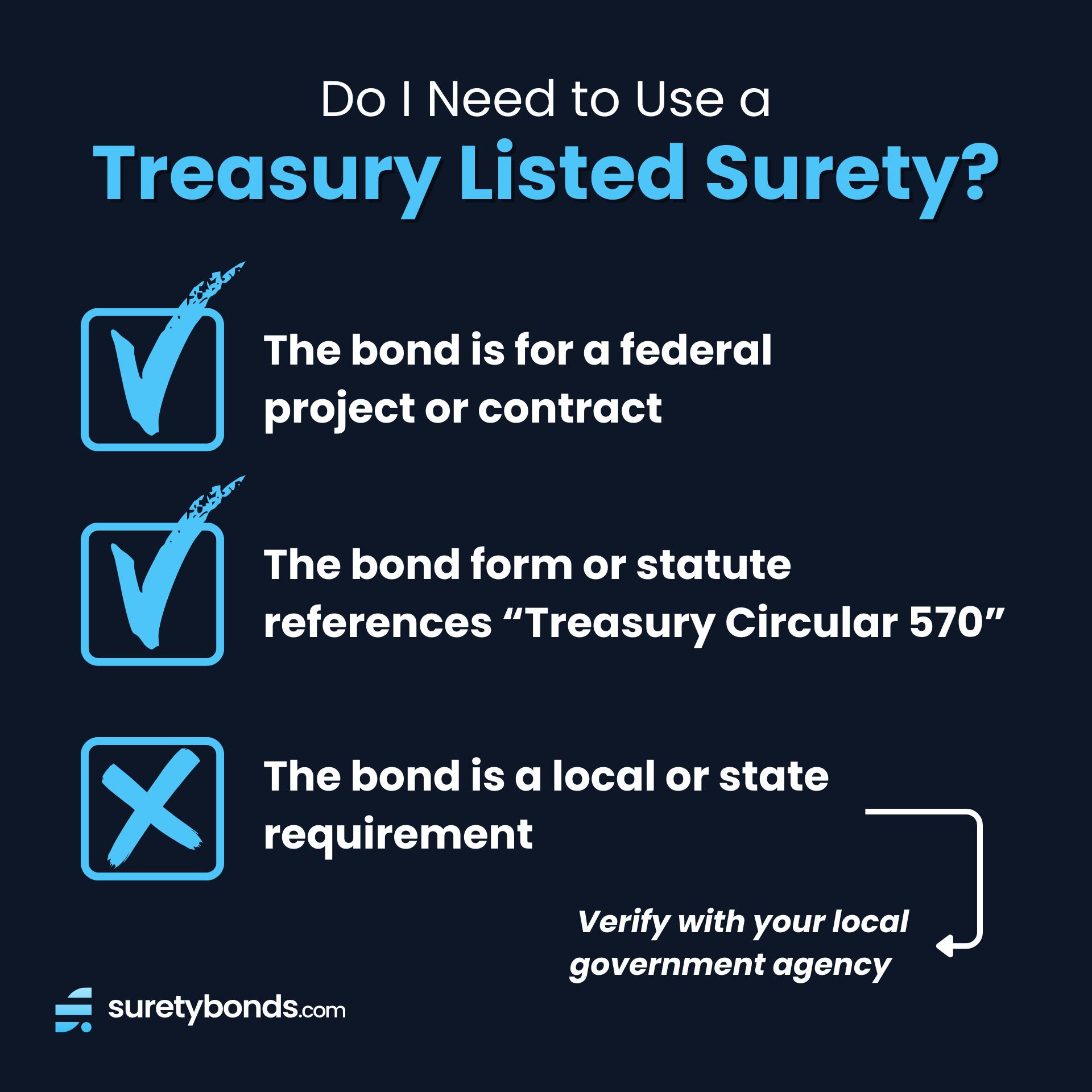
T-Listed sureties are typically required for federal bonds, especially for public construction projects. They’re also sometimes needed for high-stakes bonds.
You can use the following guidelines to help determine whether a T-Listed surety may be required:
| Obligee or Requirement Type | T-Listed Surety Requirement |
|---|---|
| Is the obligee a federal agency or federal court? | A T-Listed surety is almost always required. |
| Does the bond form or statute reference “Treasury Circular 570?” | A T-Listed surety is explicitly required. |
| Is it a state/local requirement only? | Usually not required. However, you should always check with your local government agency. |
Some of the most common bonds that require Treasury-Listed sureties include the following:
- U.S. customs bonds
- Federal contract bonds under the Miller Act
- Court fiduciary bonds involving federal jurisdictions
What Is the Miller Act?
Introduced in 1935, the Miller Act put into place the current laws for public works contractors. Under the Miller Act, public construction projects valued at over $150,000 require performance and payment bonds from a T-Listed surety.
Read more about how these bonds protect the construction industry.
Are T-Listed Bonds Only Required at the Federal Level?
No, although it’s less common at the local level. Some states, municipalities and even private entities can still require a T-Listed surety for extra security. You may need one for large state construction projects, high-value court bonds or high-stakes private contracts.
Verify with the obligee if a T-Listed surety is required or even preferred. Using one may strengthen your application and increase your credibility.
Why Do I Need to Use a T-Listed Surety?
The U.S. Treasury certifies T-Listed sureties to guarantee the proper completion of federal projects. Non-compliant sureties can expose high-value contracts, backed by taxpayer money, to unnecessary risk.
Choosing an agency that works with T-Listed sureties offers you the following benefits:
- Guaranteed Approval: Your bond will be rejected if a T-Listed surety is required and your broker doesn’t work with one.
- Verification: When using a surety broker or agency, you may not know which surety providers they work with. Choosing an agency that is transparent about working with T-Listed sureties will save you time and money.
- Increased Trustworthiness: T-Listed sureties are reputable, trustworthy and recognized nationwide.
- Financial Security: T-Listed sureties undergo a rigorous approval process, so they are guaranteed to be financially stable and able to pay claims.
- Confidence for Stakeholders: Using a T-Listed surety signals to subcontractors, suppliers and owners that a project is financially secure.
Is a T-Listed Surety the Same as a T-Bond?
No, T-bonds are Treasury-issued debt securities used for investment. They are not surety bonds. The T-List only lists approved surety companies, not specific bonds.