
How to Become a Surplus Lines Broker
In most states, you need a surplus lines broker license if you place insurance policies with nonadmitted insurers. Licensing requirements vary by state, but many state insurance departments require you to file a surety bond.
Keep reading for an overview of the surplus lines insurance broker licensing process and answers to common questions.
What Is a Surplus Lines Broker?
A surplus lines broker, also known as an excess lines broker, is a special type of insurance producer who places coverage with insurers not licensed in the state. They fill insurance gaps when a risk is too big or dangerous for a standard insurance company.
If a traditional insurer refuses to cover a business or risk, a surplus lines broker finds a specialized insurer willing to provide coverage.
How Do I Get a Surplus Lines Broker License?
In most states, you’ll need to complete the following steps to get a surplus lines broker license. However, verify your exact requirements with your state’s licensing agency.
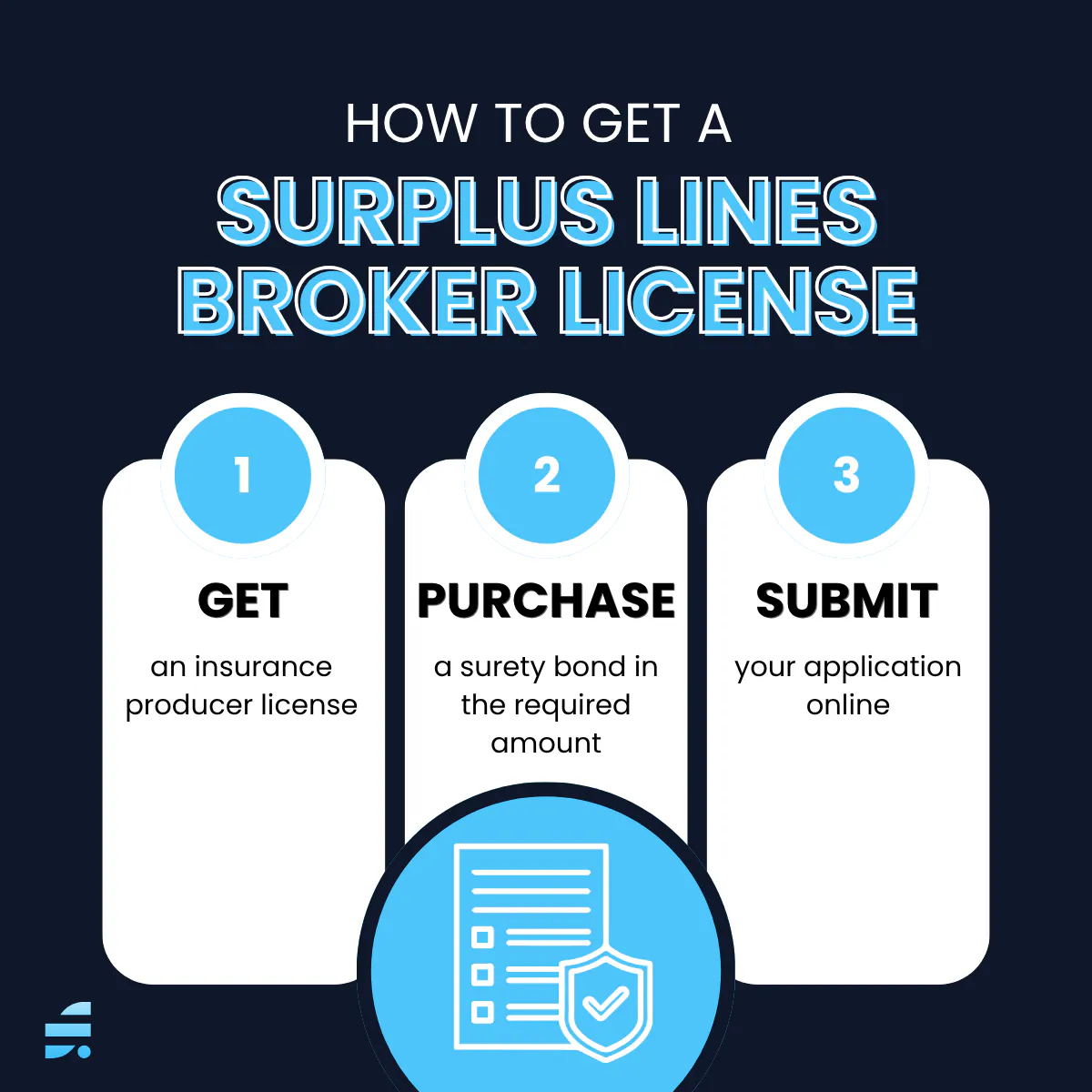
Step 1: Get an insurance producer license
Typically, you’ll need to hold an insurance producer license before you can apply for a surplus lines broker license. Most states specifically require a property and casualty license. If you’re a nonresident, you’ll need a state reciprocal license instead.
To get your insurance producer license, you may need to complete an education course or pass certain exams. Some states, such as Florida, only require a pre-licensing course certificate or proof of a certain amount of experience working for a licensed surplus lines agent.
Step 2: Purchase a surety bond
Many states require you to file a surety bond, with coverage amounts ranging from $2,000 to $100,000. Your bonding requirements may vary if you’re a nonresident.
| Coverage Amount | States |
|---|---|
| $2,000 | South Dakota |
| $10,000 | Maryland, South Carolina, Wyoming |
| $20,000 | Maine, Washington |
| $25,000 | Ohio, Virginia |
| $50,000 | Alabama, Arkansas, California, Florida, Georgia, Kentucky, New York |
| Amount varies based on gross premium collected and tax liability | Oklahoma, Michigan |
You can purchase your surplus lines broker bond 24/7 through our online portal. Most of these bonds are set at a fixed rate and don’t require a credit check.
Step 3: Apply online
Lastly, apply for your license. Your application requirements will vary based on your residency status.
Many states offer separate individual and company licenses. You can apply online through NIPR, Sircon, or your state’s licensing portal. You’ll need to provide the following information:
- Social Security Number (individual) or FEIN (business entity)
- Name and date of birth
- License and residency type
- Surety bond form
- Payment method
Application review typically takes 7 to 10 days. Both NIPR and Sircon allow you to check the live status of your application.
How to Renew Your Excess Lines Broker License
Most surplus or excess lines broker bonds expire every two years. The expiration date may be a statewide mandate or based on your birth month.
Complete your renewal through the same online portal you used to apply. You’ll also need to maintain your producer license and surety bond.
Note: Even if your license expires biennially, you still need to renew your surety bond annually.
How Much Does It Cost to Get an Excess Line Broker License?
The expenses related to your surplus/excess line broker license are typically: the surety bond premium, the application fee and the insurance producer license fee.
Exact costs will vary widely by state. Explore our state-specific surplus lines broker bond pages for more information.
| Fee Type | Amount |
|---|---|
| Surety Bond | $100–$1,000+ |
| Application Fee | $50–$1,296 |
| Insurance Producer License | $50–$200 |
Depending on your state, you may also need to consider the cost of exam fees, prelicensing courses and fingerprinting.
Surplus Lines Broker License FAQs
Do I need a nonresident or a resident surplus lines broker license?
You always need a resident license in your home state, which is where you are located and primarily do business.
You’ll also need a nonresident license in the state where your client is headquartered or has the greatest portion of risk. Even if that client has locations in other states, you only need a nonresident license for the insured’s home state.
Check with your state agency to see whether your home state qualifies for reciprocity. Regardless, you may still need to pay nonresident license fees and provide a separate surety bond.
How can I verify my state’s exact requirements?
If your state uses NIPR, you can find your exact fees and licensing prerequisites on the state requirements page. Otherwise, you’ll need to contact your state department for exact information.
Do I need to pass an exam to get my license?
Most states don’t mandate an exam. However, some states, like Georgia and Washington, require you to pass a surplus lines broker exam before applying or within a certain time frame after applying.
Even if you don’t need to take a specific surplus lines broker exam, you may still need to pass an exam to get your initial insurance producer license.
Do I need to complete continuing education?
Surplus lines broker licenses don’t have separate continuing education (CE) requirements. However, your insurance producer license likely requires CE covering general property and casualty topics, ethics and state law. You’ll typically need to complete this every two years before renewal.
Can I print my license?
If you applied through NIPR, you can print your license for free using your state’s license print tool. A digital copy will also be available through your account.
If you used Sircon, you can only print your license for the following states:
- California
- Colorado
- Georgia
- Indiana
- Minnesota
- Mississippi
- Nevada
- Texas
- Utah
- Virginia
- Wyoming
If your state isn’t listed, Sircon can’t print it directly. Instead, you’ll need to use your state’s own licensing website or printing partner, which might charge a small fee.
How much do surplus lines brokers make?
According to ZipRecruiter, the average salary for surplus lines brokers nationwide is $82,428. In comparison, insurance producers typically make $59,095 annually. Surplus lines brokers typically make more than regular insurance producers because they have access to high-value, niche markets.
What is the surplus lines tax?
The surplus lines premium tax is specifically charged on insurance policies written by non-admitted carriers. This ensures the state doesn't lose tax revenue when a business uses an out-of-state insurer.
The client pays the tax, but the surplus lines broker is legally responsible for calculating it, collecting it from the client and remitting it to the state. Each state has its own rate, typically ranging from 1.5% to 6%.
Last Updated: June 2, 2026