In this guide, you’ll learn the step-step-process on how to get a South Carolina residential builder’s license. We’ll break down the eligibility requirements, surety bond details, exam topics, and more.
What’s the Difference Between a Contractor’s License and a Builder’s License?
A South Carolina residential builder can construct, repair, improve or re-improve any residential building as long as the structure is not over 3 stories or more than 16 units. Any residential construction project over $5,000 requires a license.
There is also a general building contractor license and a residential specialty contractor license:
- Residential Builder: Can only work on residential property
- General Building Contractor: Can work on all property types and sizes — residential or commercial
- Residential Specialty Contractor: Can do specialized work on residential properties
In this guide, we’ll focus on the residential builder license specifically, but many of the steps overlap across license types.
How to Apply for Your Residential Builder License
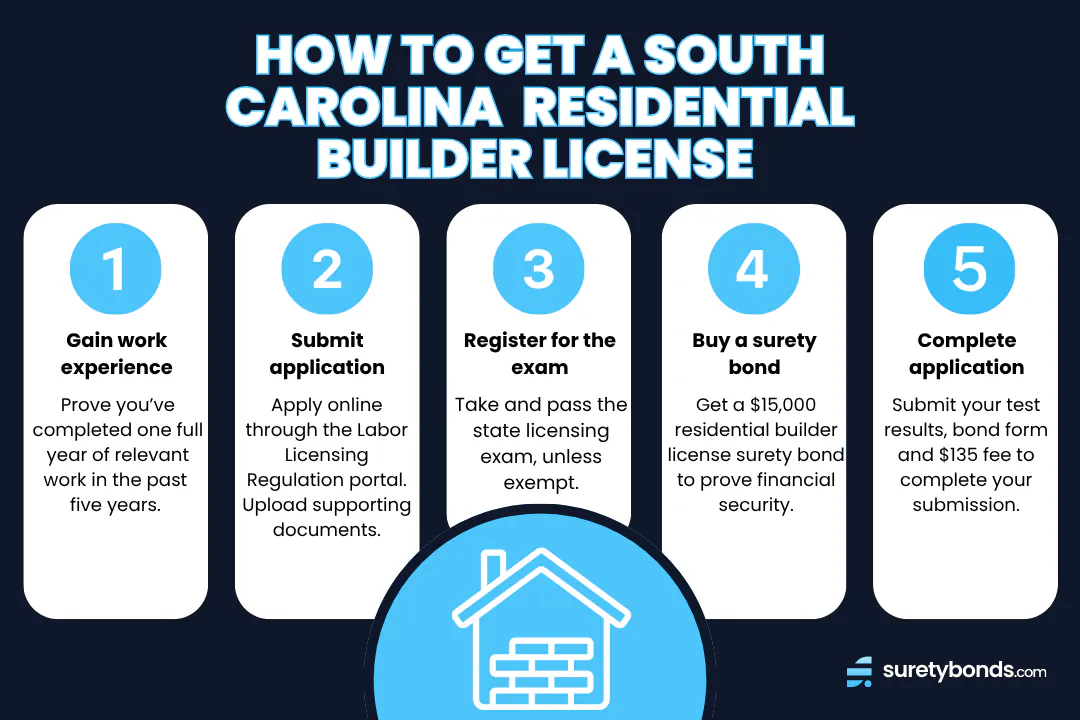
Follow these five steps to get your license with the South Carolina Residential Builders Commission.
Step 1: Meet the experience requirements
The main eligibility requirement is having proof of one full year of relevant work experience completed within the past 5 years.
You’ll need a Residential Builder Experience Affidavit for each employer showcasing your work experience as well as W2 or 1099 documents. If you don’t have tax documents, you may be able to submit letters instead.
Step 2: Submit online application
Apply online through the Labor Licensing Regulation portal. You’ll upload these documents with your residential builder’s license application:
- Credit report pulled within the last month.
- Company name and information (if operating under a company name)
- Copy of a government ID and social security card
- Residential Builder Experience Affidavit for each employer showcasing your work experience
- W2 or 1099 form copies for work experience
- Other supporting documentation of work experience or training in residential building
- Verification of Lawful Presence Form (notarized, if applicable)
- Explanatory Statement Answer Form (if applicable)
Step 3: Register for exam
After you apply, you have a full year to correct or provide any missing information. You also have 12 months to pass the state licensing exams. You’ll get an Exam Eligibility letter with information to contact PSI and schedule your exam, unless you are qualified and chose to waive it.
Step 4: Submit results, bond and fees
After you pass, submit your test results, original $15,000 surety bond form and $135 license application fee to complete your submission.
You’ll also need to submit a state background check if you answered “Yes” to any questions on the criminal background part of the application.
How Hard Is the South Carolina Contractor Exam?
The SC contractor licensing exams can be difficult, as they require technical knowledge as well as business law and management. However, PSI provides optional practice tests to help contractors study.
There are two sections to the SC residential builder licensing exam:
- Residential Builder technical section
- Business Management and Law section
You have 12 months to pass the full exam with up to 3 tries. If you don’t pass on the third try, you’ll have to wait a full year to retake it.
Many people want to know if the exam is open-note. You can use reference materials, you just can’t have sticky notes or other temporary tabs on them during the exam.
Can I Waive the State Exam?
You cannot waive the SC business management and law exam, but you can waive the technical exam portion.
You can waive the technical exam if:
- You’re already a South Carolina general contractor with the BD or LB classification
- You’re licensed in Alabama, Georgia, Louisiana, Mississippi or North Carolina
- You passed the NASCLA Commercial General Building Contractor exam in the last 3 years
If you waive the technical portion of the exam, you will not be able to work in mechanical trades, including electrical, plumbing, and HVAC services.
What Can a Licensed Residential Builder Do in South Carolina?
Once you’re licensed you are authorized to construct, superintend, repair, or improve any residential building projects over $5,000. This includes any building with 1–3 floors and 1–16 units.
There are some limitations. As a residential builder, you cannot work in residential specialty or mechanical contractor areas without a separate license. You are also not allowed to subcontract other specialty contractors to complete work that falls outside of your license.
To expand the types of work you can perform, apply for a residential specialty contractor license in addition to your residential builder’s license.
Residential specialty contractors are independent contractors who provide specialized construction work such as plumbers, electricians, painters, HVAC technicians, masons, carpenters, and various material installers.
More Resources
Last Updated: April 28, 2026