Vermont Money Transmitter Bond Overview
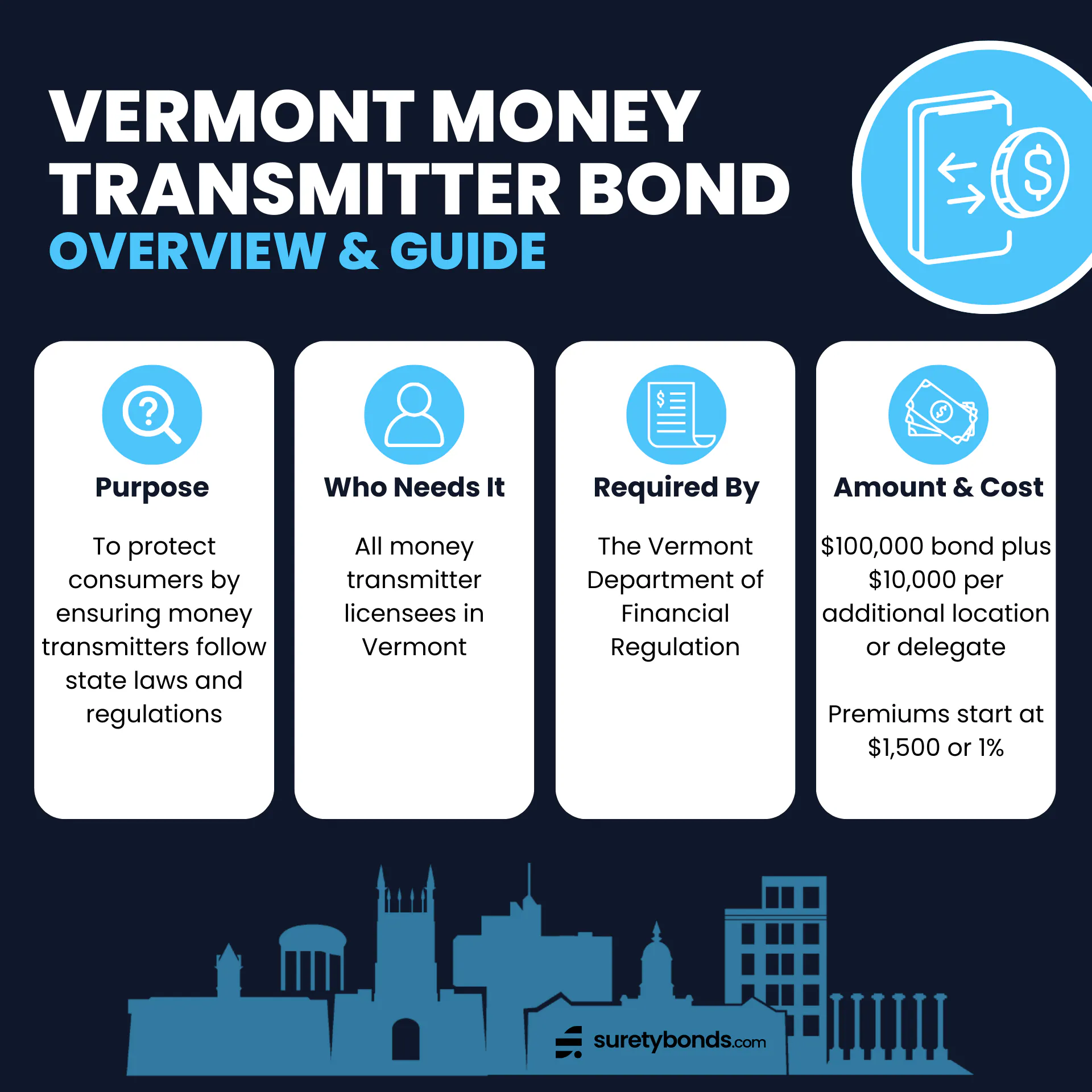
- Purpose: To protect consumers by ensuring money transmitters follow state laws and regulations
- Who Needs It: All money transmitter license applicants in Vermont
- Regulating Body: The Vermont Department of Financial Regulation
- Bond Amount: $100,000 plus $10,000 per additional location or delegate
- Minimum Price: $1,000 or 1%
What Is a Vermont Money Transmitter Bond?
A Vermont money transmitter bond is a form of financial security required for licensing of money transfer businesses in the state.
They protect clients by ensuring that money transmissions are done according to state laws and license regulations.
Who Needs a Money Transmitter Bond?
Filing a minimum $100,000 surety bond is mandatory for all money transmitter license applicants in Vermont. Some entities are exempt from both the license and bond requirement, but if you need the license, you also need the bond.
Bond Coverage Requirements for Vermont Money Transmitters
To become licensed, all Vermont money transmitters need a minimum $100,000 minimum surety bond, plus $10,000 for each additional location or authorized delegate.
The maximum bond coverage is $500,000, even if you have more than 40 locations/authorized delegates.
How Much Do Money Transmitter Bonds Cost in Vermont?
The cost of a $100,000 Vermont money transmitter bond starts at $1,000 and varies based on credit score and other financial criteria. If you need a larger bond amount, you can expect to pay 1–10% of the total coverage amount.
Apply to get your personalized quote in one business day or less.
SuretyBonds.com offers the lowest available rates from our nationwide provider network with no added fees.
How Does a Vermont Money Transmitter Bond Work?
This bond protects your clients and the state if your business engages in fraud, malpractice or goes out of business. It creates a contract between three parties: the principal, obligee and surety provider.
| Bond Party | Description |
|---|---|
| 1. Principal | The money transmission business owner(s) filing the bond |
| 2. Obligee | The Vermont Department of Financial Regulation requiring the bond |
| 3. Surety | The surety provider issuing the bond |
Under this contract, you promise to uphold your obligation (all state rules and regulations) to the Vermont DBR, who represents the interests of your clients as well.
If there are claims on the bond to reimburse damages, the surety will validate and pay. Then, the principal must reimburse the surety.
How Do I Get a Money Transmitter Bond in Vermont?
You can apply for your bond online in minutes. Follow these steps:
- Verify your required bond amount
- Complete the quote request form on this page
- Receive your personalized quote within one business day
- Pay for the bond online
- Authorize the surety in NMLS
You may be asked to submit additional financial statements to ensure we qualify you for the lowest available rate.
How Do I File My Bond?
The surety will upload the electronic surety bond to NMLS on your behalf. You’ll need to go to your “Tasks” tab in NMLS then “Surety Bonds” to authorize the surety. After granting authority, you will be officially bonded.
Can I Get Bonded With Bad Credit?
Principals for these bonds (money transmitters) are involved in a high-risk industry directly related to handling consumer funds. Because of this, it can be difficult to qualify for a money transmitter license and bond with poor personal credit.
However, if you have bad credit, you may be able to strengthen your application by providing personal and business financial statements and proof of industry experience.
How Do I Renew My Money Transmitter Bond?
To renew your bond, pay your renewal invoice when prompted by the surety. You’ll need to renew annually to maintain active coverage along with your license.
If your bond amount needs to be increased because you’ve added location or authorized delegates, please contact us or your surety provider.
How to Get a Money Transmitter License in Vermont
Illinois processes all money transmitter licenses through the Nationwide Multistate Licensing System (NMLS). First, make sure you are:
- Registered as a Money Services Business (MSB) with FinCEN
- Registered with the Vermont Secretary of State
To apply, you’ll need to create a NMLS profile and complete the application forms. There are many required documents including the following:
- MU1 Company Form and all supporting documents
- MU2 Individual Forms and all supporting documents
- Financial statements
- Surety bond (uploaded by the surety)
There are several documents that you’ll email to the DFR Banking Division at [email protected] rather than uploading to NMLS:
- Projected monthly sales volume in Vermont for your first 2 years and the maximum dollar value you’ll be liable for at any point in time
- Background check and credit report information for all control persons
- Affidavit of prior activity
- Parent corporation financial statements
Note: If your money services business is getting licensed in five or more states, we recommend exploring the MMLA program to make the licensing process more efficient.
How Much Does Licensing Cost?
The Vermont DBR charges a $1,000 application fee for money transmitter license applicants. There is also a $120 NMLS processing fee to consider and the cost of purchasing your surety bond.
| Fee Type | Amount |
|---|---|
| Application Fee | $1,000 |
| NMLS Processing Fee | $120 |
| Surety Bond | $1,000+ |
There are also fees for credit reports and background checks, depending on how many indirect owners or control persons you have.