How to Enroll in the Oregon Weight-Mile Tax Program
If you’re an oversized motor carrier in Oregon, you’ll need to enroll in the Oregon Weight-Mile Tax Program. Continue reading for step-by-step enrollment instructions and tax rate information.
Do I Have to Enroll in the Weight-Mile Tax Program?
All vehicles in Oregon that operate at a Gross Vehicle Weight (GVW) over 26,000 pounds must register for the Weight-Mile Tax Program. This program is mandatory and allows you to avoid paying fuel tax at the pump.
If you’re only in Oregon for a short period of time, you can apply for a temporary pass and pay the weight-mile tax upfront. However, if you operate in Oregon on an ongoing basis, you must enroll your vehicle in the program and file regular tax reports.
What Are the Tax Requirements for Oregon Motor Carriers?
The Oregon CCD calculates your weight-mile tax rate based on your vehicle’s maximum operating weight. You must declare the highest weight your vehicle will operate at during the reporting period, based on its heaviest expected load and configuration. Even if your truck is returning empty, you still use the same declared weight as when loaded.
You can then use your declared weight to find your rate in the following tables:
- 26,001–80,000 pounds: Weight-Mile Tax Table A
- 80,001–105,500 pounds (divisible and non-divisible loads): Weight-Mile Tax Table B
If you haul the following bulk or resource materials, you may qualify to pay your taxes on a flat fee basis:
- Forest products (logs, poles, wood chips, sawdust, etc.)
- Construction and aggregate materials (sand, gravel, rock, asphalt/concrete mix, ores, and similar materials from mines or quarries)
- Farm vehicles under 46,000 pounds operating intrastate for-hire with a valid permit
How to Enroll in the Oregon Weight-Mile Tax Program
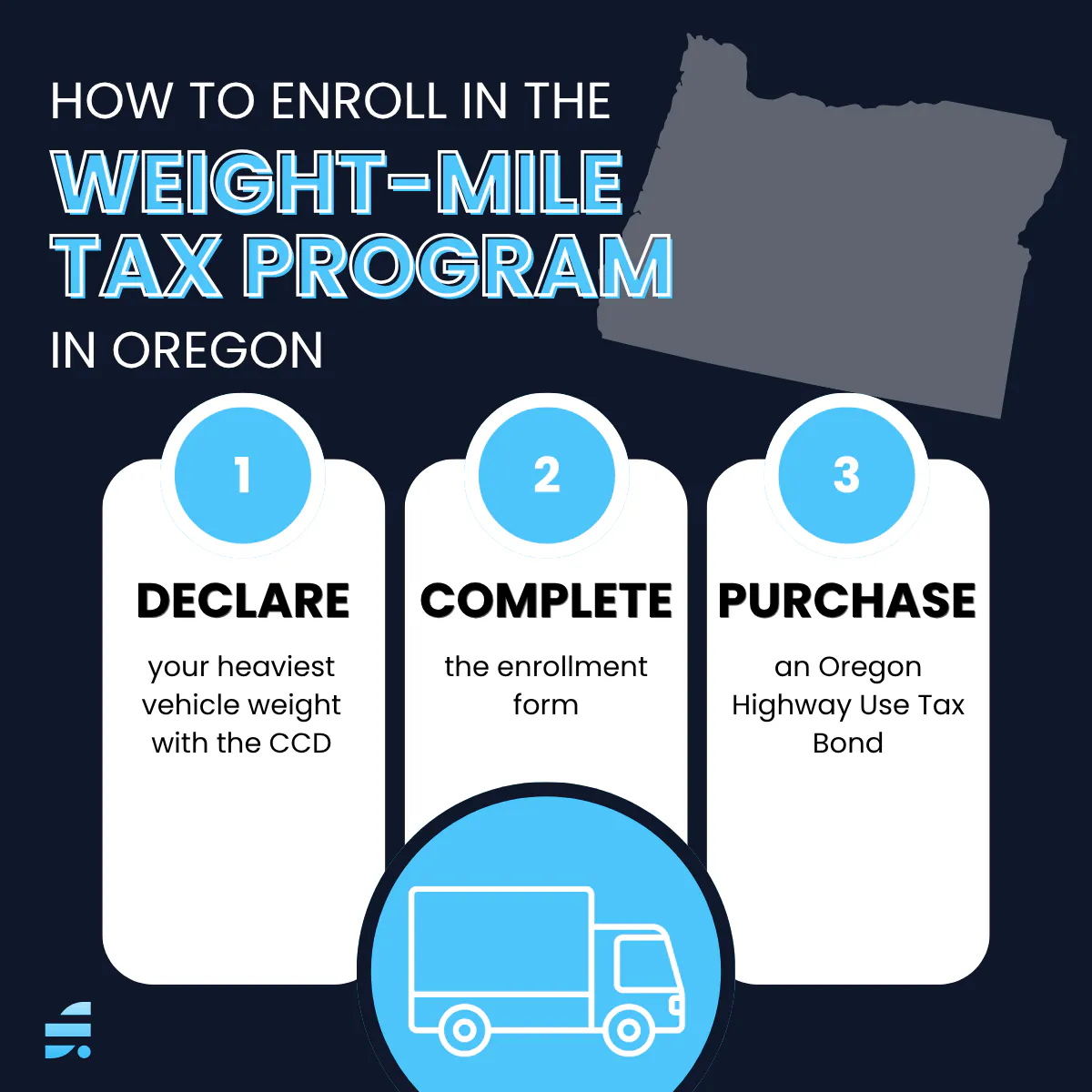
It only takes three simple steps to register for the overwise vehicle weigh-mile tax program.
Step 1: Declare your tax weight
First, you must declare your vehicle’s heaviest operating weight to determine your exact tax rate. The CCD will audit and approve this number.
Step 2: Complete the enrollment form
Next, apply for the program by paper or online. You can submit the enrollment form by fax to 503-378-6880 or by mail to the listed address. If you have an established Oregon Trucking Online account, you can apply directly through the portal.
Step 3: Purchase a surety bond
All new program participants need an Oregon Highway Use Tax Bond. This bond guarantees you’ll pay all taxes on time and keep accurate records.
After submitting the enrollment form, the CCD will mail you a letter with instructions and coverage details. Your required bond amount will vary from $2,000–$50,000 based on the number of vehicles you operate.
Note: You’re only exempt from the bond requirement if you have a Dun & Bradstreet rating of 3A2 or higher.
How to Renew Your Tax Program Enrollment
You don’t need to renew your enrollment unless you meet one of the following criteria:
- You’re amending or cancelling vehicles
- You’re changing the account’s ownership structure
- You need to renew Oregon registration exempt plates (YE), which will otherwise be cancelled
You can complete your renewal either by mail, in person or through your Oregon Trucking Online account.
How Much is the Pay Per Mile Driving Tax in Oregon?
Oregon mileage tax rates vary from $0.0764 per mile for lighter trucks up to $0.2411 per mile for the heaviest vehicles. For example, if your vehicle weighs 30,000 pounds and you drive 1,000 miles in Oregon, you would owe $80.90. You can determine your exact rate based on your vehicle weight using the Mileage Tax Rates table.
While there’s no enrollment fee for the Weight-Mile Tax Program, you may need to pay the Road Use Assessment Fee (RUAF) if your vehicle weighs 98,000 pounds or more. The CCD calculates this extra fee based on your weight, axles and driven miles.
More Oregon Weight-Mile Tax Program FAQs
Can I Get a Temporary Pass?
Yes, if you’re only operating in Oregon temporarily, you can get a 10-day pass. Since the estimated mileage tax is required upfront, you don’t need to purchase a surety bond or file a tax report.
What Are the Reporting Requirements for Oregon Motor Carriers?
As a program participant, you’ll need to file highway use tax reports regularly, even when not operating in Oregon and when no taxes are due. The CCD may suspend you if you don’t file accurate reports.
You’ll need to list your travel routes, dates, miles and other relevant details. Forms and instructions to file reports and pay taxes are available online. Late reports can incur fines and penalties.
You’ll automatically be enrolled in monthly tax filing. You can request quarterly filing if you meet all of the following criteria:
- 12 consecutive months of on-time filings
- No suspensions related to reporting or payment of taxes or fees
- No revocation of your IFTA tax license
- No repayment plans
- No delinquent over-dimensional or RUAF fees
- No audits in the past 36 months that resulted in large assessments
Do I Need to Stay Enrolled if I Stop Operating in Oregon?
The CCD recommends canceling your vehicle’s enrollment in the Weight-Mile Tax Program as soon as you cease operations in Oregon. You can un-enroll by sending written notice, calling a CCD office or cancelling online through your TOL account.
What Are the Overweight Hauling Requirements in Oregon?
If your vehicle weighs 80,000 pounds or more, you’ll need to apply for a Special Transportation Variance Permit to operate.
| Load Size | Permit Type |
|---|---|
| Divisible loads (with one declared weight) over 80,000 pounds | Extended Weight Permit |
| Non-divisible loads that are 80,001–98,000 pounds | Annual Heavy Haul Permit |
To request a permit, call the Over-Dimensional Permit Unit at 503-373-0000. All permits are valid for one year from the date of purchase.
Can I Be Exempt From the Bond Requirement?
All new program enrollees must file an Oregon Highway Use Tax Bond. However, the CCD may waive your bond requirement in future years if all of the following criteria are met:
- 12 consecutive months of on-time filings
- No suspensions.
- No late or missing payments
- No outstanding billings
What Is the Overweight Vehicle Fine in Oregon?
The maximum weight for trucks without a permit is 80,000 pounds. Under ORS 818.430, standard overweight carrier fines increase based on the amount of excess weight:
| Excess Weight | Fine |
|---|---|
| 1,000 lbs | $100 |
| 1,000–2,000 lbs | $150 |
| 2,000–3,000 lbs | $200 |
| 3,000–5,000 lbs | $300 |
| 5,000+ lbs | Fines calculated at a rate of 15–24 cents per pound |
You can also be fined if you have a permit and exceed your maximum permit weight. These amounts are typically higher and may also result in suspension of your license or registration.
Why Do I Need to Pay a Weight-Mile Tax in Oregon?
In Oregon, weight-mile taxes ensure overweight vehicle compliance and fund highway maintenance. While lighter trucks only need to pay fuel tax at the pump, heavier vehicles need to enroll in the Weight-Mile Tax Program to document and cover the costs of their impact on the roads.
What Is the Maximum Height of a Heavy Vehicle Without an Oversize Permit?
Under OAR 734-082-0025, you need a permit if your vehicle exceeds 14 feet in height. Height permits are typically not valid if your loads are stacked or overlapping.
More Resources
Last Updated: June 10, 2026