Hawaii Money Transmitter Bond Overview
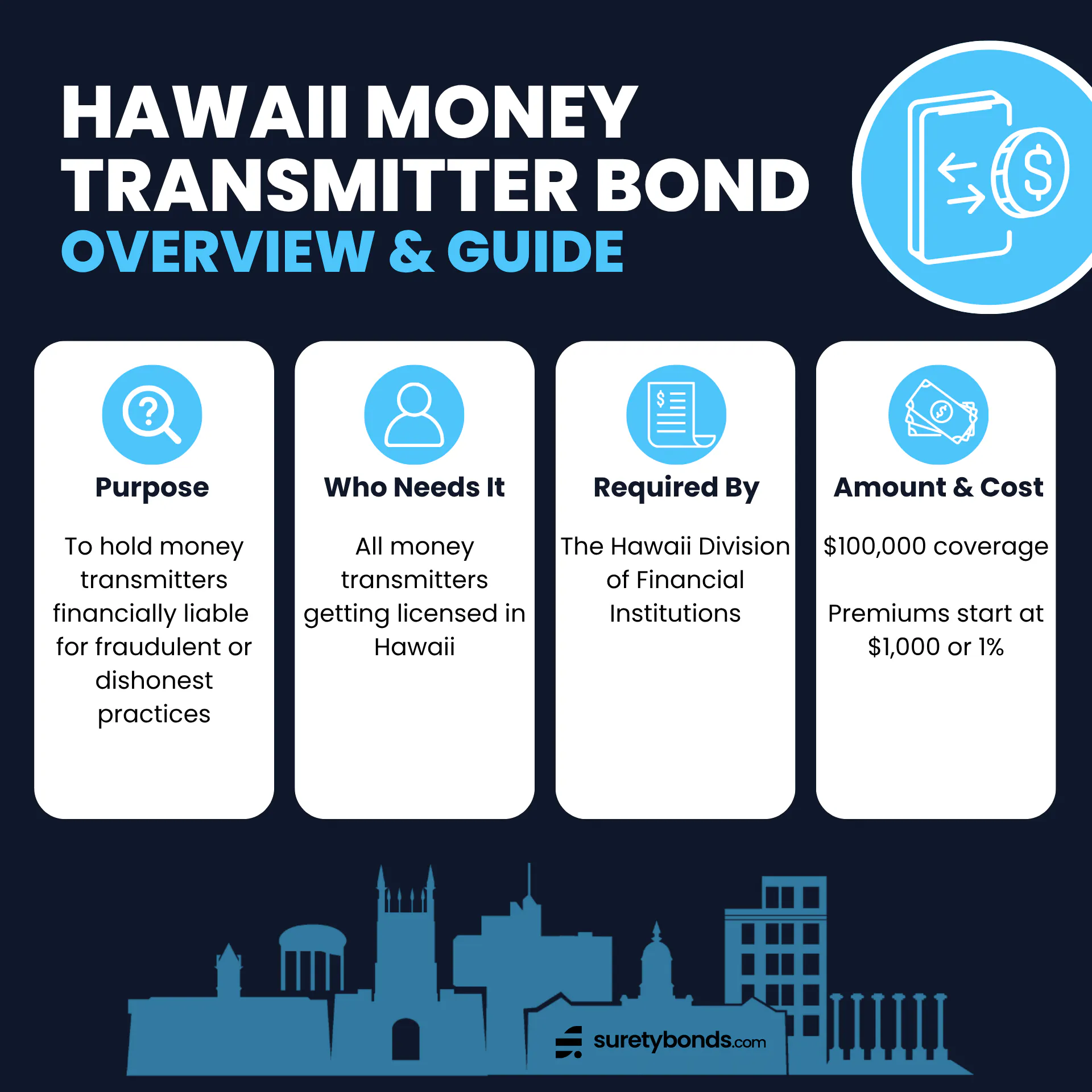
- Purpose: To hold money transmitters financially liable for fraudulent or dishonest practices
- Who Needs It: All money transmitters getting licensed in Hawaii
- Regulating Body: The Hawaii Division of Financial Institutions
- Bond Amount: $100,000
- Minimum Price: $1,000
What Is a Hawaii Money Transmitter Bond?
A Hawaii money transmitter bond protects the state and consumers from unethical money transmission practices. It also ensures that you’ll submit honest financial records to the Division of Financial Institutions.
Who Needs a Money Transmitter Bond?
Anyone providing money transmission services for people in Hawaii must be licensed and bonded with the Department of Commerce and Consumer Affairs’ Division of Financial Institutions.
This includes any business that sells checks, issues money orders or receives money for transmission. Payroll processors are exempt from the license and bond requirements.
Note: Cryptocurrency kiosk operators are considered money transmitters, however, our surety markets do not currently issue these bonds for crypto-based clients.
How Much Do Money Transmitter Bonds Cost in Hawaii?
The $100,000 Hawaii money transmitter bond premium typically costs $1,000 to $5,000 for one year of coverage. Your exact rate will depend on your personal credit score and the credit score of any other owners on the bond application.
The surety may also need to review personal and business financial statements to determine your financial stability. But don’t worry, SuretyBonds.com makes this process quicker and easy. Apply now to get a free quote in one business day or less.
SuretyBonds.com offers the lowest available rates from our nationwide provider network with no added fees.
How Does a Hawaii Money Transmitter Bond Work?
This type of license and permit bond creates a legal contract between the money transmitter, the Hawaii DFI and a surety provider.
| Bond Party | Description |
|---|---|
| 1) Principal | The bonded money transmission business owner(s) |
| 2) Obligee | The Hawaii Division of Financial Institutions |
| 3) Surety | The issuing surety provider |
As the bond principal, you must uphold your obligation to the DFI, or pay financial damages if not. The surety pays out valid claims up to the coverage limit, but unlike insurance, you ultimately have to repay the surety.
How Do I Get a Money Transmitter Bond in Hawaii?
You can get your Hawaii money transmitter bond as quickly as the same day. We always provide quote application responses in under one business day.
Complete these simple steps to get bonded:
- Apply for a quote online
- Provide any information and signatures when prompted
- Purchase the bond online
- Authorize the surety in NMLS
How Do I File My Bond?
After you purchase the bond, the surety will upload the electronic surety bond to NMLS on your behalf. You’ll need to go to your “Tasks” tab in NMLS then “Surety Bonds” to authorize the surety.
We’ll provide this information in an email as well. After you grant authority, you will be officially bonded.
How Do I Renew My Money Transmitter Bond?
You’ll need to renew your bond every year to maintain coverage. Just pay for your renewal premium when prompted by the surety to extend your term for another year.
How to Get a Money Transmitter License in Hawaii
First, make sure you registered as a money services business (MSB) with FINCEN and registered with the Hawaii Secretary of State.
Then, you can apply for a Hawaii money transmitter license online through the NMLS. You’ll need to upload various documents, including financial statements, business information, sample documents, and more.
Follow along with the NMLS licensing checklist to make sure you don’t miss any important information.
How Much Does Licensing Cost?
There is a $5,000 application fee plus a $5,000 license registration fee. The NMLS also charges a $120 processing fee for your online submission.
If you have licensing questions, you can email the DFI at [email protected].