Illinois Money Transmitter Bond Overview
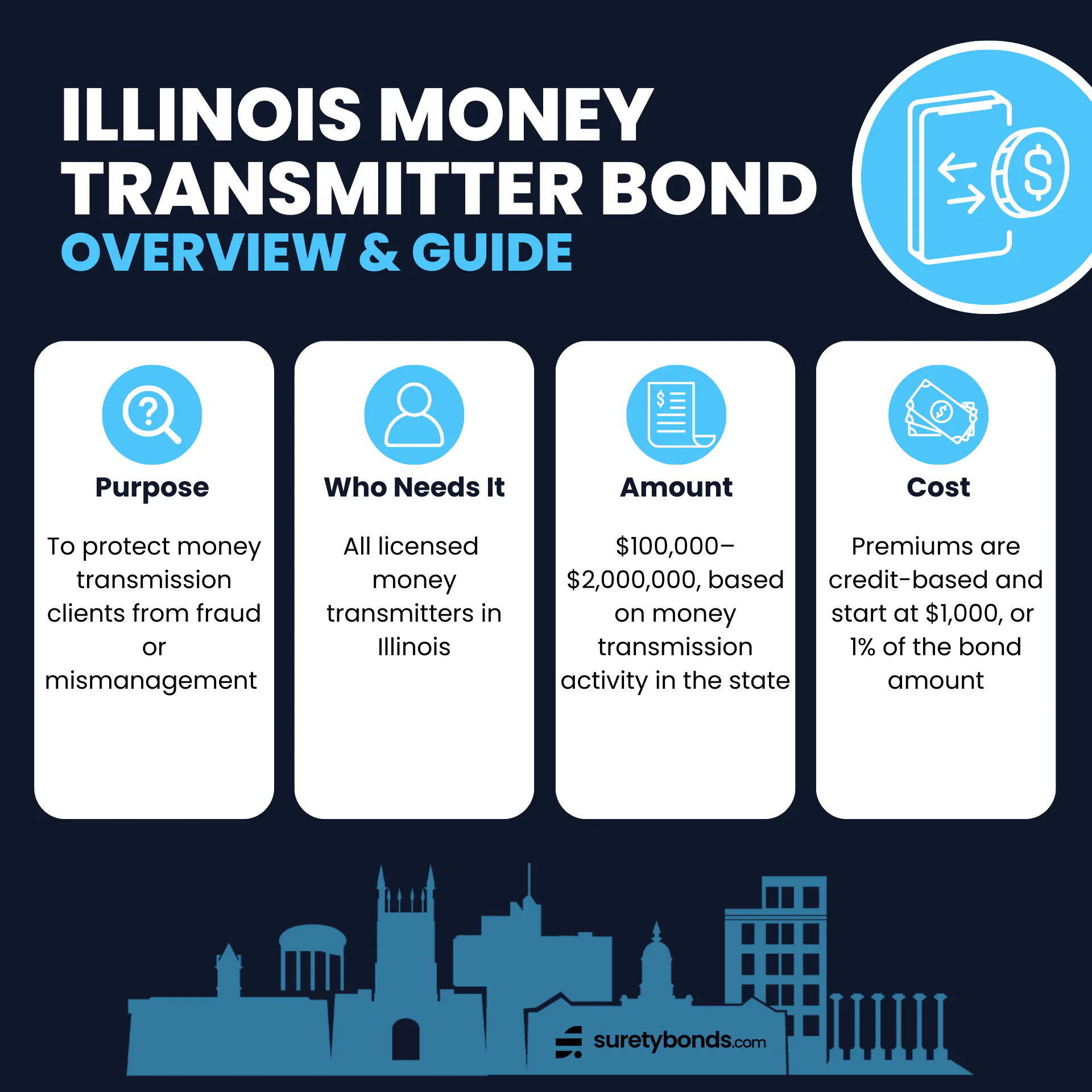
- Purpose: To protect money transmission clients from fraud or mismanagement
- Who Needs It: All licensed money transmitters in Illinois
- Regulating Body: The Illinois Department of Financial and Professional Regulation
- Bond Amount: $100,000–$2,000,000
- Minimum Price: $1,000 or 1%
What Is an Illinois Money Transmitter Bond?
Illinois money transmitter surety bonds ensure that money transmitters follow industry laws and regulations. They are required by the Illinois Department of Financial and Professional Regulations (IFDPR) to protect clients from fraud and malpractice.
Who Needs a Money Transmitter Bond?
Illinois joined 24 other states by adopting the Multistate Money Services Businesses Licensing Agreement in 2025. This nationwide regulatory framework sets clearer guidelines for money transmission services and mandates licensing and bonding for all money transmitters.
Anyone performing the following activities needs a money transmitter bond for licensing in Illinois:
- Selling and issuing payment instruments
- Transmitting money
- Exchanging currency
Bond Coverage Requirements for Illinois Money Transmitters
Your bond amount must be the greater of $100,000 or an amount equal to 1% of all Illinois-based money transmission activity with a $2 million maximum.
All money transmitter companies are required to have a minimum $35,000 net worth as well for additional financial security.
How Much Do Money Transmitter Bonds Cost in Illinois?
Illinois money transmitter bond premiums typically cost 1–10% of the total coverage amount based on credit score. For example, highly-qualified applicants could pay as low as $1,000 for the base $100,000 coverage.
You may be able to provide personal and business financials to strengthen your application. Apply for your free quote now.
SuretyBonds.com offers the lowest available rates from our nationwide provider network with no added fees.
How Do Money Transmitter Bonds Work?
These bonds ensure that Illinois money transmitters abide by all state laws, rules and regulations. Prohibited acts outlined in the Illinois Transmitters of Money Act include:
- Selling checks as an agent without a license
- Having a non-approved party handle money on behalf of a client
- Withholding, deleting, destroying or altering information requested by an examiner
- Making false statements to the department
If you break these rules, the bond protects the state and consumers harmed from financial loss up to the full bond amount.
How Do I Get a Money Transmitter Bond in Illinois?
We make the bonding process quick and easy for Illinois money transmitters. Just submit the quote request form on this page.
A surety expert will get back to you within one business day or less to provide your quote or request additional information.
How Do I File My Bond?
The surety will upload the electronic surety bond to NMLS on your behalf. You’ll need to go to your “Tasks” tab in NMLS then “Surety Bonds” to authorize the surety. After granting authority, you will be officially bonded.
How Do I Renew My Money Transmitter Bond?
This bond lasts for one year after the filing date. To renew, you’ll need to pay your renewal invoice annually. The surety will provide a continuation certificate to show the state that you still have active bond coverage.
If there are claims on the bond, the surety can cancel the bond by providing 60-days notice.
Can I Make Changes to My Bond?
In some cases, you can request a change for your existing bond form, such as the trade name or address listed. To request a bond update, email [email protected] with the details.
How to Get an Illinois Money Transmitter License
First, you need to register with FinCEN and the Illinois Secretary of State. Then you can apply for your money transmitter with the IDFPR through the Nationwide Multistate Licensing System (NMLS).
You’ll need to upload documents including:
- Financial statements
- AML/BSA policy
- Certificate of Authority
- Company formation documents
- Appointment of attorney-in-fact for service of process form
- Organizational chart
- Sample business documents
- Business plan
- Surety bond form
See the full checklist in NMLS to ensure you meet all the application requirements. Any control persons will need to fill out the MU2 form and all supporting documents as well, including a credit report.
You can contact the IDFPR licensing staff at [email protected] with questions.
Note: If your money services business is getting licensed in five or more states, we recommend exploring the MMLA program to make the licensing process more efficient.
How Much Does It Cost to Get Licensed?
The Illinois DFPR charges a $2,500 application fee for new money transmitter licensees. You’ll also pay a processing fee to NMLS and will need to purchase the surety bond.
| Fee Type | Amount |
|---|---|
| Application Investigation Fee | $2,500 |
| NMLS Processing Fee | $120 |
| Bond Premium | $1,000+ |
What Are the Net Worth Requirements for Money Transmitters?
Illinois has different net worth requirements for money transmitters than most states. The net worth is directly correlated to the number of business locations you intend to use in the state, starting at $35,000.
| Number of Locations | Net Worth Required |
|---|---|
| 1 | $35,000 |
| 2–3 | $50,000 |
| 4–5 | $100,000 |
| 6–9 | $150,000 |
| 10–14 | $200,000 |
| 15–19 | $300,000 |
| 20–24 | $400,000 |
| 25 or more | $500,000 |
If you’re opening a new company, you’ll need to provide unaudited profit and loss statements as well.